-
 Almost all glaciers around the world are shrinking or retreating and many are disappearing entirely. As this goes on, glaciers are drawing more visitors than ever. The ten most visited glaciers now attract more than 14 million tourists each year. Glaciers have long been tourist attractions, but the impact of climate change has led to the growth of “last-chance tourism” where visitors are rushing to see glaciers before they vanish.
 -
 Greenland is one of the fastest-melting cryosphere regions on Earth. In fact, scientists say the large-scale melting of the Greenland Ice Sheet is irreversible, and it’s happening now at an accelerating rate. Understanding what is driving this melting is crucial for predicting how much sea levels will rise and what that means for coastal communities around the world.
 -
 There are around 200,000 glaciers in the world and virtually all of them are melting with the rate accelerating. More than half of the world’s population makes use of meltwater from glaciers and snow for drinking, agriculture, and energy. Nearly 2 billion depend on seasonal glacier melt that supplies rivers and aquifers. This is especially true in Asia and in the Andes.
 -
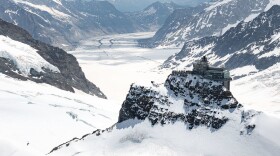 Switzerland has over 1,400 glaciers. Some of them are world famous, including the largest one, the Aletsch Glacier, which is a World Heritage Site located in the Barnese Alps. At its deepest point, it is about 3,000 feet thick. But like other glaciers in Switzerland, the Aletsch is shrinking – by more than 150 feet per year due to global warming. In total, more than 1,000 small glaciers have melted away entirely since the 1970s.

© 2026

Play Live Radio
Next Up:
0:00
0:00
Available On Air Stations


