© 2025
Play Live Radio
Next Up:
0:00
0:00
0:00 0:00
Available On Air Stations
Strange Universe With Bob Berman

The Winter Solstice

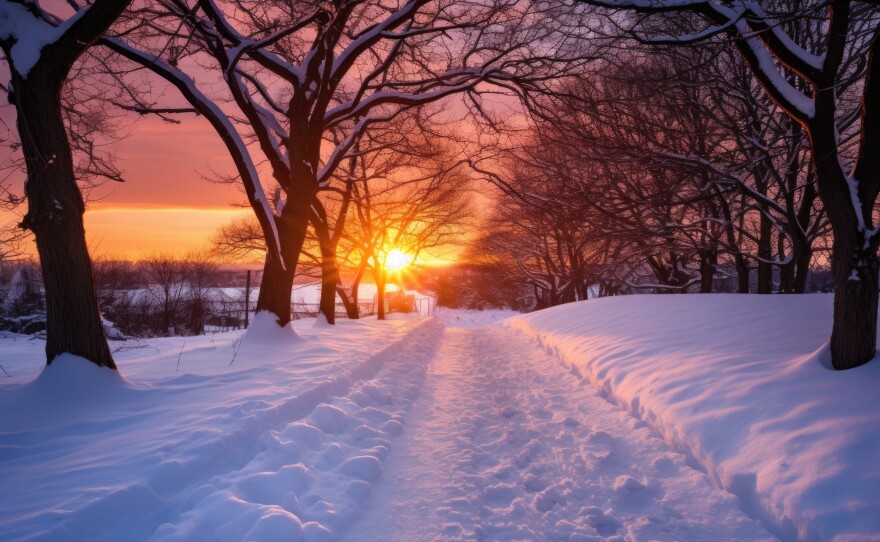
The winter solstice occurs on Sunday, December 21, around nightfall, when Earth’s south pole tilts most directly toward the Sun, giving the Northern Hemisphere its shortest day of the year; starting Monday, daylight increases slightly and the Sun climbs higher, bringing a hint of added warmth. The Sun rises and sets at its most extreme points along the horizon, and although often labeled the start of winter, that date is a human convention rather than a physical change. Astronomically, the solstice features the Sun’s most curved, rainbow-like path across the sky, reaching its lowest noon height of the year and producing the longest shadows.

Related Content
  • Strange Universe With Bob Berman
    On December 7 we get the year’s earliest sunset, followed by the shortest day on December 21 and the darkest morning in early January. This timing doesn’t match the solstice because Earth’s tilt and elliptical orbit make our solar day slightly longer than 24 hours as we move fastest near early January. That small shift moves sunrise and sunset milestones off the solstice, meaning the darkest-feeling afternoon of winter arrives now.
  • Strange Universe With Bob Berman
    The universe is shaped by four fundamental forces, including gravity and electromagnetism. The latter’s strength is described by the dimensionless constant alpha (about 0.008), a value long puzzling to scientists such as Wolfgang Pauli. In 2010, astrophysicists analyzing quasar light found that alpha appeared slightly larger in one direction of the sky and smaller in the opposite, suggesting this supposedly unchanging constant might vary across the cosmos. Tune in to hear how such a directional shift would challenge Einstein’s relativity, hint at an even larger — possibly infinite — universe with fundamentally different cosmic “neighborhoods,” and suggest that life exists here partly because our region of the universe is unusually suited to it.
  • Strange Universe With Bob Berman
    My autograph collection includes a handwritten note from Aldous Huxley saying “Gratitude is heaven itself,” a fitting thought with Thanksgiving approaching. I’m thankful for many things, including resisting the urge to play mood music at my observatories, since tastes differ and silence still best suits the Orion Nebula in Ulster County. The holiday also prompts a modern cosmological question: whether the universe is an interconnected whole with some underlying intelligence rather than a product of randomness. This idea has scientific grounding, since the laws of physics and the four forces are astonishingly fine-tuned for life—small changes to the strong force or gravity would make stars, water, and life impossible. So we’re left to wonder whether such precision needs an explanation, and whether Nature itself might hold some unseen intelligence, as scientists continue trying to make sense of a cosmos that seems improbably well-suited to us.