


Haudenosaunee people have been living and crossing over both sides of the Niagara River for centuries. Social service organizations for Indigenous people in Southern Ontario and Western New York are working towards increasing collaboration, amid a backdrop of heightened border enforcement.
Singing, dancing and oral traditions were a center-piece of the Midwinter social at Fort Erie’s Native Friendship Centre. But that wasn’t all.
“We can learn how we can support each other, because we have family that are as transient on both sides [of the border]," said Michael Martin, executive director of Native American Community Services. "'Oh, you need that service over there,' we can refer you, and vice versa.”

NACS as it’s called, serves Native people with job training, health, cultural and other social services. They began serving Erie and Niagara counties way back in 1975, and have since expanded to 17 counties in New York.
Michael Martin, who is Six Nations Onondaga, said that longstanding norm of interconnected Native communities and families on both sides of the border has been tough lately.
“That imaginary line that we didn't put there is a barrier for people to get across," he said. "Whether it's the ID issues of having the right ID, or sometimes with the current climate, it's fear.”
Rhonda Martin, a Six Nations Cayuga, runs cultural events and Indigenous health programs for NACS.
“It's hard sometimes, you know, because we as the first people of these lands," she said. "It's hard knowing that I have to cross this border every day, this imaginary border, this thing that should not even be there, because, you know, we were once a free people.”

But Rhonda Martin said Native people are resilient, and events such as the Midwinter social bring the community together, and provide a vital outreach opportunity.
“It helps me to broaden my horizons. When other people in the community, different communities, want to know about our culture and we're open to the public, we talk about health and well being, self awareness, self care and intergenerational trauma," she said.
A focus on cultural-informed health care isn’t just happening in Western New York, but in Southern Ontario as well.
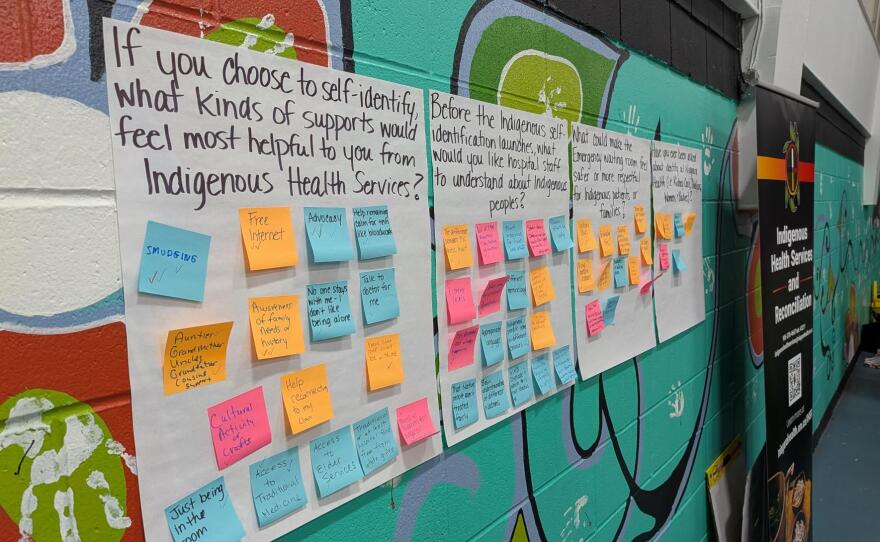
Krystal Brant is an Indigenous relationship specialist at Niagara Health, a hospital system with five facilities. Their table, among nearly a dozen set up in the Friendship Centre's gym, used the Midwinter social as a public listening session. Trying to understand how health care for Niagara’s Indigenous community can be improved.
“All the way from housekeeping up to the doctors, they're doing cultural safety, so that includes historical trauma, understanding like intergenerational trauma, and also understanding why patients might wait till the last minute before coming to the hospital, waiting till things are very critical," said Brant, a Mohawk. "Understanding that it's probably not just an infection in the foot, but it's probably diabetes or circulation, all of these different things.”

Much of the Native community packed in the gym-turned-gathering place placed an emphasis on the youth. Fort Erie Aboriginal Head Start runs pre-k and kindergarten programs for Indigenous children.
The students used their education to recite the Ganö:nyök, or Thanksgiving address, fully in the Mohawk language, and performed the water song.
Danielle Longboat is the coordinator of Aboriginal Head Start in the region.
"Not only are we implementing culture and language, we also implement mainstream curriculum so that they are prepared when they do enter mainstream schooling," said Longboat. "But it's important to identify who they are and have that connection to the culture and language. So they have that sense of belonging to the community and to their friends. So when they do go to mainstream school, they have that connection and they have each other."
Through the Head Start program, Longboat said they’re able to connect with families as a whole, providing wraparound services for parents too.

Some present for the outreach portion of the Midwinter social have been serving their communities for decades. And for others, like Jessica Ghosen of Buffalo, it’s multi-generational. She became a successor to her mother in leading the board of directors for the Niagara Chapter of Native Women.
“I feel like I'm growing into the next version of myself, and I'm hoping to inspire others, too," Ghosen, who is Cayuga, said between preparing meals for elders. "To do the same thing and go into their power and start to help out the community in more ways.”
Attendee Sabrina Shawana, who is Anishinaabe from Manitoulin Island, said the gathering felt like an evolution of what the lands of the Niagara region had been used for years ago.
“All along the Niagara River is considered neutral territory, so for all of the nations, this is where we gathered and learned how to trade with each other, how to speak each other's languages, how to understand each other, even when we came from different nations and languages and places," Shawana said. "So it's nice to see that this is still happening on this land, because I think the earth needs to feel this, and I think that we don't think about that enough.”
And that exchange of cultural teachings and language was happening at the Friendship Centre as well.
The hosts brought in Jock Hill, a Cayuga faith keeper. Organizers felt his presence and voice was important, to help reconnect Haudenosaunee people to their traditions, and share understanding to Indigenous people from other communities.

Midwinter, the namesake of February’s gathering, is an annual milestone observance for the Haudenosaunee, rooted in the lunar calendar.
Organizers say they are looking to host more cross-border collaborative events in the future, combining culture, community and support.
