

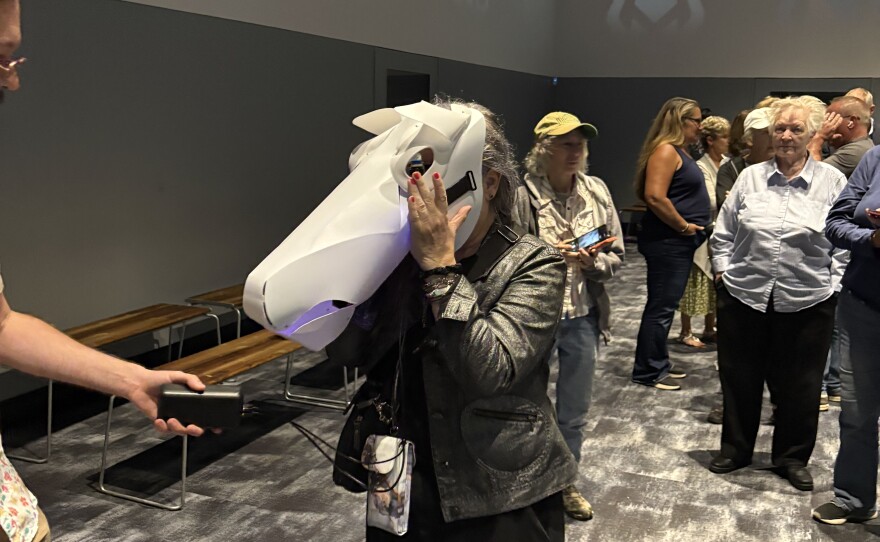
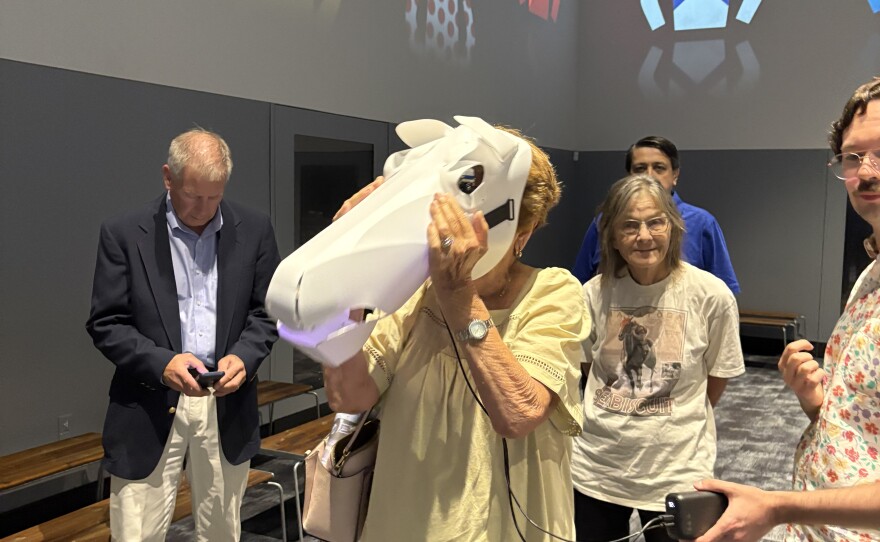
The National Museum of Racing and Hall of Fame in Saratoga Springs has acquired technology to allow visitors to see through the eyes of a horse. Its creator hopes to spur inter-species connection.
The Hall of Fame room sits at the back of the museum and it’s walls are lined with projections of famous jockey’s racing silks.
On the back wall, a PowerPoint outlines a decade's worth of work by Alan Hook, a senior lecturer at Ulster University in Ireland. He's presenting his creation: Equine Eyes.
The large, white plastic model of a horse’s head that encases a virtual reality headset splits your vision with two cameras and removes the color red as horses don’t perceive the color the same way humans do.
“I can see you right now. Wait, hold on, now you’re in my field of view, right now. Oh it’s a big blind spot in front,” said Mark Hittner.
Mark Hittner and his daughter are among the first in line after the lecture to try it on.
He says wearing the headset is a simultaneously disorienting and informative experience.
“My daughter takes a lot of lessons and to get the feel, we’ve always been told by trainers, ‘this is how you approach the horse, this is the side you approach from, this is how it feels to the horse.’ But you really never get that concept. Wearing the mask I had the ability to see at what point of contact the horse could actually see my hand coming. And at what point it feels just like a giant building approaching. So, it’s really nice,” said Hittner.
Hittner and his daughter are in town for the races – he says they’ll be going home to Long Island with a new perspective.
“It’s going to make me more sympathetic to a horse the next time we’re with it because we know how it views things how it sees things and you want to make the horse comfortable. For us, it’s less about racing the horse and more about bonding with the horse. So, I think it’s terrific,” said Hittner.
Hook would be proud.
“It’s not a scientific instrument. It’s a space for imagination and play. I always say the magic doesn't happen like in the headset. The magic happens next time you encounter a horse, and you might think about it slightly differently, and you might remember the equine eyes experience, and think, ‘Oh well, you know, maybe it's experiencing the world in this way, or you kind of reimagine the horse.’ So, I don't know how closely we can really know another species, but I think that we can open up new spaces for kind of reconfiguring and kind of reencountering,” said Hook.
Hook was inspired to create the experimental headset after his two young children became enamored with the horses that grazed in their backyard. He’s been working with immersive media for 20 years and sees this latest project as another way to rethink what it means to be human.
“So, for me, it's not just about the horse,” said Hook. “It's a wider kind of question about what it's like to be a human, what it might be like to be something else, and how might we create experiences which make people more kind of attentive, attuned to other species, and more empathetic to non-human kind of worlds?”
He adds there are few places more suitable for Equine Eyes than Saratoga Springs.
“So, like, I think that the headsets found its home in a space where people have very close bonds with horses and thoroughbreds, and I think that the museum is going to take it on in terms of education and outreach, and work with kind of school groups and those sorts of things to start to get children to think about what it might be like to be a horse, and kind of starting very early on in that cycle. I think is an important place to start to make some, or just to raise some questions and start to think wider about what our relationship to other species and the planet and plants and the world might be like,” said Hook.
The museum's two headsets will be available for public use Saturdays.
