

Weeks after a massive traffic accident near Copake, the tragedy continues to ripple through the community on a daily basis.
At Tommy B’s Pizza Joint, on Route 23 in Craryville, the owners are on the phone with a regular customer named Mark. "I'm not sure where you guys are," says Tommy B's co-owner Erin Dougherty. "Hang on, I'm gonna have to get a map out."
Mark’s coming from Great Barrington to pick up a couple pies, but he’s gotten completely turned around on his way to Tommy B’s. The normal route to the shop is blocked off, and Mark’s trying to follow a confusing series of detour signs. Erin and her partner, Aaron Butkus, are feeling helpless. "I don't know, you guys," Erin sighs. "I would just turn around, because the way that they have it going, you're going to have to go all the way around the detour."
After a few more minutes of back and forth, Mark gives up. He’s already been driving in circles for half an hour, and he doesn’t have time to figure out an alternate route. Aaron tells him not to worry about the abandoned pizzas. "That's ok - I'll put your pies out for slices."
This kind of thing has been happening a lot lately.
Last month, just up the road from Tommy B’s, a Subaru collided with a gas tanker. The couple driving the Subaru were killed, and the tanker truck flipped over. The day it happened - April 16th - one of Tommy B’s delivery drivers ran in and said there’d been a huge accident. Aaron and Erin could tell it was bad.
"I'd say within, I don't know, maybe 20 minutes, we started smelling pretty heavy gas fumes," Aaron recalls. "My eyes were like, all red, and kind of burning from it. So it was - yeah, I mean...it was scary."
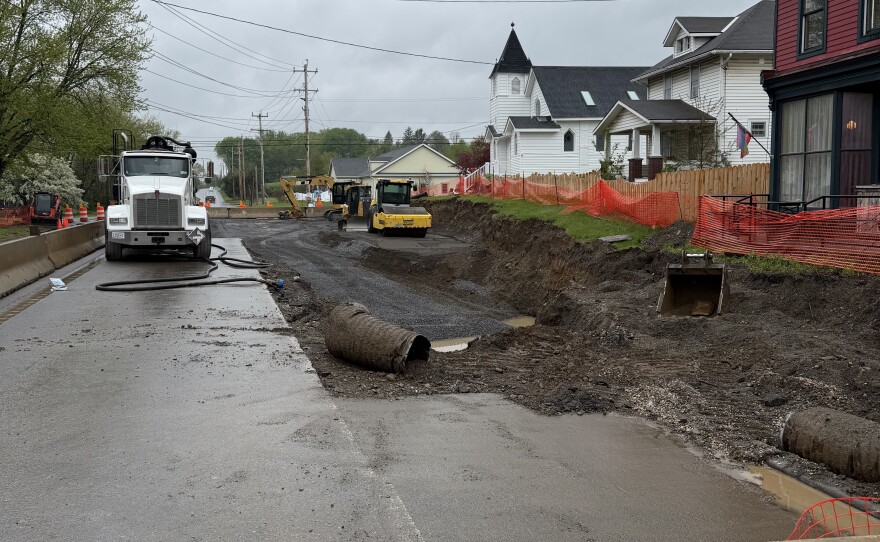
When the tanker truck flipped, it landed in the front yard of the United Methodist Church at the corner of Route 23 and Craryville Road. Thousands of gallons of gasoline spilled, seeping into the soil and a nearby creek.
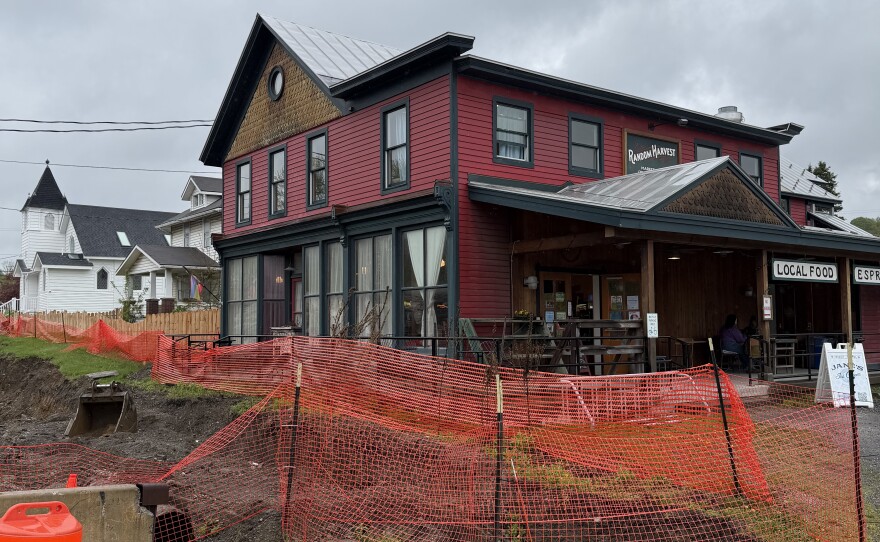
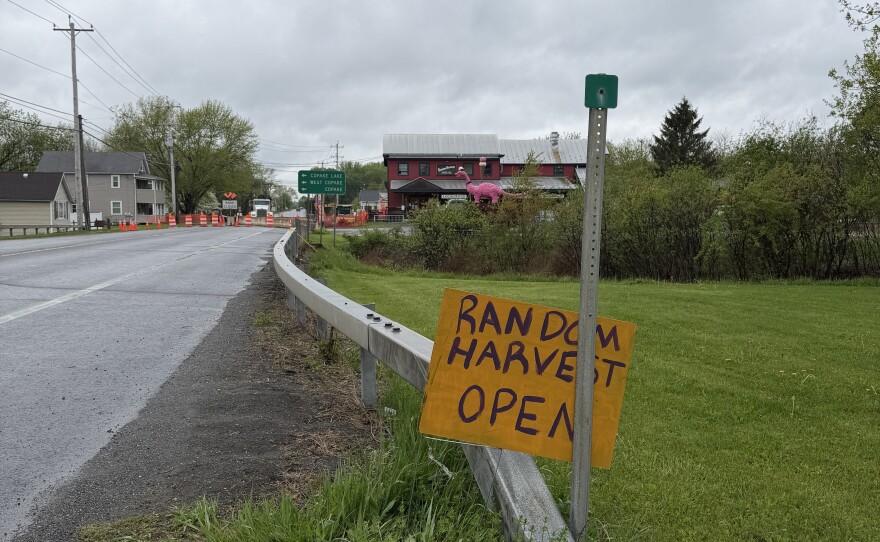
When I visited the spill site earlier this week, Department of Environmental Conservation officials had orange netting blocking off a big stretch of Route 23. Road crews had dug deep trenches to try and excavate the contaminated soil, which was being carted off to a safe disposal site. They scoured ground surfaces for trace elements of gasoline. Not far away, workers monitored waterways for the presence of gas, and took samples from drinking water wells. And the detour on Route 23 was still in place. Flaggers were waving traffic off the road, where hand-painted signs offered directions to local businesses, like Tommy B’s and Random Harvest, a food co-op.
Hillary Hawk, one of the owners of Random Harvest, told me the detour has had a significant impact on their business, with profits down an estimated thirty to fifty percent. We spoke at a small table in the store’s cafe, near the front door, which was propped open to keep the space ventilated. During our conversation, a handful of customers filtered in and out of the shop – some of them wearing face coverings.
Tommy B’s owners, Aaron and Erin, also said their business is down at least 30%. With no announced end date for the clean-up work, Hillary has organized a series of community fundraisers with performances from local musicians. It’s helping. But even if they’re able to eke out enough money to get by until the detour is over, the tragedy of the crash looms large. "I feel like this spill is so significant of the world that we don't want to live in anymore. Meaning the need to get off of fossil fuels, and the fact that this happened right now, in this political moment where the Strait of Hormuz is closed, and everything that's happening that's just so horrific," Hillary said. "It feels like, very close to home. Like the global scale, and then the micro scale of, like, how destructive fossil fuel is."
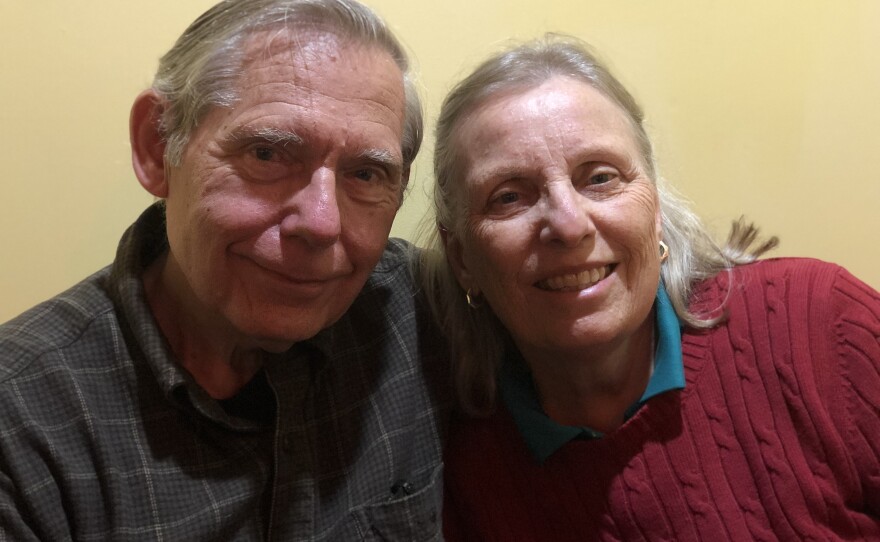
For Stephen Piwowarski, the crash hit too close to home – both of his parents died in it. I reached Stephen by phone in his office at a high school, where he’s a band director. I could hear his students practicing bassoon in the background. He told me that his father, John, would have agreed with Hawk’s sentiments. "I think to say that my dad was an environmentalist," said Piwowarski, "would be almost, like...not enough."
Growing up, Stephen said, while a lot of kids spent their weekends playing soccer, John would bring him to the family’s cabin in the Hudson Valley. They spent entire days walking through the woods. "Just clearing trails, you know, doing bird identification, looking at reptiles and amphibians. That is the dual tragedy of the accident. Not only did I lose my parents, there's also the aftermath. An environmental disaster, which my dad would just..."
Piwowarski paused. "There's just no words for how he would feel about that."
Recently, Stephen’s been going through some of his parents' things. Among other keepsakes, he found a tote bag that belonged to his mom, Janet.
In recent years, she’d been a volunteer in a program called Stories Across Generations at Taconic Hills Central School District. Every week, she met with students during lunch to read to them. One of Janet’s students was fascinated by Native American culture. So Janet had been teaching herself how to speak Algonquin.
"When I went into the tote bag," Piwowarski said, "She had, like, pages where she had translated words from English to Algonquin, and starred the ones that were important that she should look at with him."
In his parents’ obituary, Stephen wrote that Janet would’ve wanted everyone to know that they are loved and deserving of love.
Stephen and his family live in Maine, where he’s often reminded of his parents in small ways. "Just this morning," he said, chuckling, "I was coming in to school, and I go to open my classroom door, and there's a bullfrog just sitting in front of the door. And it was just this nice little reminder of my dad."
Stephen took the bullfrog into the woods and found a damp spot to re-home it – just like he and his dad used to do on their hikes.
"I mean, he knew that animals, and the environment can't speak for itself. So they need champions in people."
