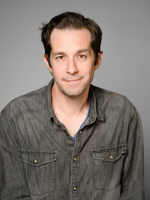
Democratic U.S. Rep. Josh Riley is running for re-election to represent New York's 19th Congressional District, covering big parts of the Hudson Valley and central New York. A lawyer and former policy analyst at the U.S. Department of Labor, Riley was elected to Congress in 2024.
In a recent conversation with WAMC's Sam Dingman, Riley said he views corruption and affordability as the central issues of his campaign — and that he sees the two issues as related. Backroom deals between lobbyists and politicians, he said, are driving up costs for everyday New Yorkers. To get a sense of his relationship with the life of everyday New Yorkers, Dingman began his conversation with Riley by asking him if he thinks his two years in Congress have changed him.
INTERVIEW TRANSCRIPT
Editor's note: This conversation has been lightly edited for clarity.
Riley: At the end of the day, you know I'm still a dad. That's the main thing. I see myself as a dad before I see myself as a politician, certainly. Tonight, I'm going after this interview, I'm going to my son's soccer practice, and then I'm going from there down to Endicott to get pizza and beer with a bunch of my buddies from high school. ... you know, some of them are Bernie Democrats on the left, some of them are MAGA Republicans on the right, and at the end of the day, we may disagree on some of our politics, but we grew up together, so we have a shared set of values. We love each other, and you know, I like to think I've stayed pretty grounded in a really tough business.
Dingman: I want to come back to you on this question of your buddies on both sides of the aisle. But before I get there, I want to ask you some questions about some specific issues, as well as your opponent, state Sen. Peter Oberacker. If you had to say the one thing where you feel like you disagree most with state Sen. Oberacker, what would that be?
Riley: I only get to pick one.
Dingman: You can only pick one.
Riley: One of the main differences I think that really impacts folks day to day is our different approach to fighting against the utility companies. I have fought the utility monopolies tooth and nail. I'm the first member of Congress ever to intervene in the Public Service Commission proceedings to fight against the rate hikes, to put the corporate executives under oath. I sued my own party's Public Service Commission [member] to reverse the Central Hudson rate hikes.
Dingman: So it might not surprise you to learn that when I asked state Sen. Oberacker this question, he brought up the utilities question and what the best way to get ratepayers the best deal is. He said that his approach to that is the most significant difference between his campaign and yours. These are his words, not mine, of course, but his feeling seems to be that lawsuits just end up dragging things out and generating headlines, whereas he says he's more focused on solutions. What is your response to that?
Riley: So just to be clear here, what the approach is. You know, he has one piece of legislation that he introduced [in the New York State Senate] after he decided to run for Congress. If you look at that piece of legislation, for the most part, it is just doubling down on a failed status quo. I don't think anybody should be surprised that the politician in this race who pocketed a bunch of money from the utility monopolies is just doubling down on the failures we've seen for so long.
Dingman: Thank you, Congressman. And just to put another one of his allegations against you, to you, and get your reaction to it. He has said that your vote against the One Big Beautiful Bill [Act] was "a vote against the American worker." Do you stand by that vote? And assuming that you do, what kind of legislation would you like to see advanced — should Democrats retake the House — that would better address your constituents' needs?
Riley: Look, everybody across upstate New York who I've talked to sees the One Big Beautiful Bill as exactly what it was, which was taking $1 trillion out of the public health system, taking that money out of the pockets of the most vulnerable folks in our community — folks who can least afford it — and adding $3 trillion to the debt, all to give $4 trillion of tax breaks to the biggest corporations, the biggest data centers, and the biggest campaign donors. What I think we need to do is the opposite. We should be investing in healthcare, especially investing in rural healthcare. And so, what I have done is bipartisan legislation. The Rural Hospital Stabilization Act would undo a lot of that damage for our rural communities. I've introduced the Bipartisan Care Over Profits Act. It says more of the money you're shelling out for your premium and for your care should actually go toward your care. My priorities are with the people I represent, and they deserve better than that.
Dingman: Speaking of the people you represent, Tompkins County, that's where Cornell University is located. It's obviously part of your district. It has been at the center of the national conversation in a very intense way in recent weeks because of the allegations against the seven fraternity members at Cornell who allegedly participated in a gang rape. I did ask Sen. Oberacker these questions, so I want to make sure I give you a chance to answer them as well. The governor, Kathy Hochul, recently made news by appointing
[state Attorney General] Letitia James as a special prosecutor in that case, sort of superseding the Tompkins County [district attorney]. I want to get your reaction to that, and I also want to know what you think can be done at the federal level to address what many see as a chronic issue of sexual assault on college campuses.
Riley: Yeah, no, absolutely. I mean, it's just absolutely horrific and sickening, the allegations. And what I think the community deserves, and what everybody involved deserves, is the truth and justice. On the federal level, look, I think one of the things that I've worked on previously in my career, and I think needs to be updated and strengthened, is VAWA, the Violence Against Women Act. It provides really important resources for local law enforcement and for universities to deal with these issues because clearly they need to be dealt with, and we're dealing with a pretty toxic culture in some corners of campus life.
Dingman: So you would like to see that bill come before a hypothetical Democratic House in the next session?
Riley: Yeah, I think it's up for reauthorization pretty soon, and I think one of the things that we should all be looking at as that happens is what additional resources and support are needed, not just on our universities, but generally to prevent anything like this from happening, but also to make sure justice and accountability is had.
Dingman: Do you mind if I ask you, Congressman, again, just because this is something that came up in the other conversation [with Oberacker]. I'm interested to get your perspective on this. What do you think we do about the culture of sexual assault, particularly amongst young men? And if I may ask you, you know, as a father of boys, I wonder if you have thoughts on this.
Riley: Yeah, I mean, you touched on it. I think, like, we've got to raise better boys and better men. My wife and I, you know, every day we try to teach our kids respect and dignity. And you know, I don't know that there's like a magic wand that you can wave to solve a lot of these cultural issues, but I think it starts with just treat others the way you want to be treated, and that sounds so simple, but it's also really profound.
Dingman: Is there anything that you can offer us as by way of advice? I mean, how do you stay friends, for example, with — you're going to go have pizza and beer you said tonight, and — you have some friends from high school who are MAGA-identified. I imagine, you know, there's a lot that you disagree with them about. You can still have pizza and beer with them, clearly. Is there anything you can offer us in terms of how you approach those conversations that might be a bit of an analog for how you see your work in Congress more broadly?
Riley: Yeah, there are so many things in life that run so much deeper than our political parties and our political identities. These are folks who, like all of our parents, worked in the factories when the factories closed down. One of the guys that I'm talking to tonight, he said he saw his dad cry one time in his whole life, and it was when the plant closed down. Like those sorts of experiences bond you. It's interesting because I do get that question a lot, and when I tell folks, you know, I'm a Democrat. I come from a Republican family, for example. People find that surprising outside of upstate New York because our politics are so divided and so toxic. But here in upstate New York, it's just sort of how we approach things. We see ourselves as upstate New Yorkers first. That's the approach I'm trying to take to the job. And frankly, I think the national politics and the politicians down in the swamp could learn a thing or two from us.
WAMC spoke a few weeks ago with Republican state Sen. Peter Oberacker, who is challenging Josh Riley in the 19th District. Listen to that conversation here.