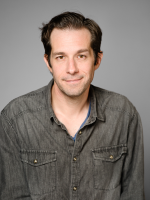
Honorah Bullough walks the streets of Troy with a phone and a microphone. She asks people she meets to talk about their experiences, and then she edits their answers down into short, punchy videos. The on-the-ground portraits of who is out and about in the streets of Troy also show how those people perceive the place that they live. The series on Instagram, TikTok and Facebook is called "What's Troy Thinking." Bullough discussed the project and how it came to be on Northeast Notebook Live with WAMC's Sam Dingman and Molly Anderson.
INTERVIEW TRANSCRIPT
Editor's note: This conversation has been lightly edited for clarity.
Dingman: So, let's give folks a little bit of backstory. You told me a story that I wonder if you could repeat, and it was about — you grew up in Troy, right?
Bullough: Correct.
Dingman: Okay. And somebody said something to you when you were young that really stuck with you.
Bullough: Yes. Yes. So, if anyone's listening here and they have also grown up in Troy, you know how much Troy has changed throughout the years, and especially over the last 10 years. I grew up in Troy. I'm in my 20s, and I went to a small private school called Loudonville Christian. It's [a] very affluent, very, very wealthy school. And I, you know, I was someone who lived in Troy, and the bussing for Troy for the school district of Troy was called Durham bussing, and I remember getting off. I was in seventh grade, so at that point, you really care about what people think about you at that age.
Dingman: Oh yes
Bullough: And I was getting off the bus, and I hear someone. They're like, "You live in Troy?" Like it was almost like a derogatory in my head.
Dingman: Kind of a sneer to it?
Bullough: Yeah, kind of like a sneer to it. In my head. I was like, yeah, like I already didn't feel that I fit in there, but it was at that comment, and I from that time and coming on being, I always was like,"Why couldn't I have grown up in Latham or Loudonville or in those mansions there? You know, there is a lot of Troy's rich in hits culture, and I have grown up really appreciating that. But I think just other people's perceptions of the city really impacted, like, my confidence in, you know, where I lived.
Dingman: Yeah, that's an early experience with, you know, the idea of a place being perceived a certain way, which is why it's kind of fascinating to me this project you're doing because you're capturing the way people perceive Troy now. I wanted to play a clip from the series to kind of give folks a sense of it. This is, I would say, very typical of the videos that you make. Let's take a quick listen.
Bullough: I'm Here with...
Hoffman: Roland Hoffman.
Bullough: What brought you to Troy?
Hoffman: We chose to find a place that was more accepting. We lived in a very rural area on Long Island, so we decided to find a place that's full of Black Lives Matter flags and rainbow flags. We started with looking at a place in Albany. As we're, like, checking out a place in Puerto Rico, we find a place sight unseen. We rent a place here in Troy, New York. We're in love with Troy.
Dingman: So, what really resonated with me about this clip with Roland is that he is somebody, it seems to me, who is in transition, and you know, is deciding to make this real change in his life. And actually, there's another video that you have up where somebody literally says to you, "Troy is a city for people in transition." Does that resonate with you? That idea.
Bullough: Yes, especially. So there, there is more than Troy than just the downtown. I've gotten luck finding people to interview downtown, but especially in that downtown area, it is almost like its own little universe, like the nightlife, the restaurants, the communities, and if you're in a period of change, like, just from doing these a month into doing these, like I've made so many friends and acquaintances that it's almost the town wraps around you. And I know it's not a town, but I say it kind of like it is a town because it's not like your typical city. So when you're in that period of change, like especially Roland coming here, so many people I've met came from Brooklyn — maybe during breakups — the town kind of just inculminates you, and it's a safe landing pad. That someone literally said those exact wordings in my videos, and I couldn't agree more.
Dingman: This is making me think of in that video where they say this is a city that attracts people in transition. Both of the people you spoke to in that video say, "I moved here with my ex." That didn't work out, but then one of the people has gone on to live there for 13 years. I think the other one has now lived there for six. And I had this thought watching it, like, you know, the relationship with a person that they moved there for didn't last, but the relationship with the city really did. It really took root.
Bullough: I will tell you, this is a little personal side thing. I had actually, coming out of college — so I graduated a year early — came back to Troy. A couple months later, actually, ... [I] broke up with my boyfriend of four years. So that was also a period of transition in itself. So while I'm also hearing these stories, I'm kind of thinking to myself like, this is my own story, too. So many people are more similar than you realize.
Dingman: So you have a real resonance with that storyline?
Bullough: Yes
Anderson: And something that I've seen come up a lot in these videos is the way that people talk about how Troy feels, like, conceptually. So here's an example [from Wells Liscomb of the band Westfall]:
Wells Liscomb: Big city, small scale. It feels residential and artist-friendly.
Anderson: So, in another video, someone says it feels like a city that turned into a town, and that resonates for me as someone who just moved to Troy. So, do you hear that a lot as well?
Bullough: Yes. And before doing these, I've never actually heard it phrased that way, but it is because, you know, the downtown — and Molly. I know you said you live in Troy — it's so busy, and then you get outward, and it is. There's areas that feel disconnected, and the architecture does give very old-town vibes and the familiarity. But then you think about it, and it's the city of Troy. It's not the town of Troy. But the such familiarity feel kind of makes it feel like you're in a rural area when you're not.
Dingman: That was the experience I had going to the Troy Waterfront Farmers Market for the first time. Is that there were all of these legacy Troy businesses, farmers markets, and people who make lotions and oils and record stores and stuff. All of these places that have been in Troy for such a long time, but because of the, you know, appeal of Troy as an increasingly a destination for people to move to, it was just swarmed with people who were new to the community, who were then bumping up against these businesses and the people who run the businesses that have been a part of the city for a long time. So it was this real, like, collision it felt like. There is also a sense in the videos, Honorah, of Troy as a city that is in transition itself, as we were just alluding to. And one woman [Ivy Liscomb of the band Westfall] who you spoke to tells you that she sees Troy as kind of blossoming into an artistic hub.
Ivy Liscomb: I was actually born in Troy. We moved out pretty shortly, you know, when I was really young. It's only been getting better. More artists, more art, more cool stuff, more fun stuff to do, more people, more diversity. Keep going that way, and you can't go wrong.
Bullough: What brought you back to Troy?
Ivy Liscomb: It's like the best art scene in the Capital Region.
Dingman: So that was very interesting to me, but you also in another video spoke to a Black woman [named Aujai] who works at, I believe, it was a coffee shop, and she says that not all of these transitions are super welcome.
Aujai: Everyone says that Troy is like Brooklyn. I don't want it to be like Brooklyn. Getting super gentrified is getting super expensive. I hope that it just stays like a small town that has more diversity in the future, so just way more, like, Black and brown people, and just a lot less ... mmm.
Dingman: So that's a very telling "mmm" at the end there. Can you talk a little bit about that? I don't know whether tension is the right word, but has that been a recurring theme in these conversations?
Bullough: Yes, especially, I've been hearing a lot about the gentrification of Troy. And I think with any sort of development — Troy used to be an industrial town. It was the Collar City. They made collared shirts. It was factories. It has gone through so much up and downs, and unfortunately, just because one part of Troy is now becoming more populated, more investing, it brings a divide. There's a divide, and all of Troy, like I would say, that one central [area] where I normally film near Monument Square, not all of Troy is equally invested in. So absolutely, it's not all equal in the town. But I will say, just doing this project, meeting so many diverse voices, I am so happy that I got to interview those two individuals separately because, like, those are the real stories that not everyone would know by just looking at the town or visiting,
Dingman: Right, absolutely, especially if you just come for something like the farmers market, you know, and it's lovely and everything, but you might not notice these subtleties and nuances. Molly, can I ask you, as someone who just moved to Troy, I mean, you've watched some of these videos. Did you recognize your new hometown in the videos?
Anderson: I did, I did. That's something that kept coming up as people were, you know, I noticed a trend of people talking about it. You know, it feels like a big city, but like a small town on a smaller scale, and I think that really shows itself in just the landscape of, like, the backdrops of your videos. You know, it's not always the same spot, but you start to notice certain, you know, familiar landmarks. I'm like, "Oh, like, that's like just down my street," or like, "That's just around the block for me." And so, you know, people I've never necessarily met before, I'm scrolling through and I'm seeing them, but they're kind of just there and where I'm familiar with. And so it makes it feel a lot bigger, actually, when I watch your videos,
Dingman: Last question for you, Honorah. You do this thing in some of the captions on the videos that I really love, and I want to know what's behind it. You write, "I'm so glad you're here." What's behind that?
Bullough: Yeah, I want everyone to know that, you know, [in] my interviews, I'm not trying to select certain people. I really just walk around the town and get whoever. But I want people to know that, like, this is a space that anyone can share their stories. I'm happy that you're here and being a part of this community because I don't want to see it divide more. I want to see it come together more. So anyone who's watching or wants to share their voice, their thoughts, or if they disagree with something that's said, I'd love for them to feel safe.
Dingman: Yeah, yeah. Well, that's that's really lovely.
Bullough: Thank you.
Dingman: It reminds me of, you know, that project Humans of New York? Have you heard of that?
Bullough: I have not personally until people have compared it to that, and I was like, "What is this?"
Dingman: I don't know if this website still exists, but it was a project that aimed to do a very similar thing, which was basically, you know, put a wide range of people's lived experience in a rapidly transforming place, just kind of alongside each other, and let those things kind of sit equally, and you kind of take your own impression away from it. So it's a really beautiful thing you're doing, and thanks for coming in to talk about it.
Bullough: Thank you, and I can't take credit for that lived experience. That is other people.
Dingman: Alright. Well, that is Honorah Bullough. The channel is What's Troy Thinking on Instagram and also TikTok. Anywhere else?
Bullough: Facebook
Dingman: Facebook
Bullough: Maybe YouTube one day.
Dingman: Maybe YouTube one day. OK. Alright. We'll keep an eye on your channels.
Bullough: Thank you.