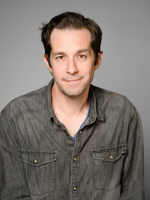
Sarah Teale is an Emmy-nominated filmmaker who's made multiple documentaries for HBO. Her newest investigation is very personal. The small town of Hebron, New York has seen a dramatic rise in Parkinson's disease in recent years. Teale and her husband Gordon have a farm in Hebron, and Gordon recently became one of the latest Parkinson's cases. In the new film Where the Sweet Birds Sang, Teale decided to get to the bottom of why so many people are getting sick in places like Hebron - otherwise idyllic agricultural communities. WAMC’s Sam Dingman spoke to Teale last week about the film:
Read the full transcript below:
Sarah Teale: From the top of our hill, we can see the Adirondacks, we can see the Green Mountains, we can see the Catskills. It's absolutely stunning, gorgeous, and yet it reminds me of the scene in Blue Velvet with the firemen going by and waving, and everything seems perfect. And then there's something not perfect going on underneath.
Sam Dingman: And in the film we discover very quickly that your husband Gordon is suffering from Parkinson's, and there are over 30 other people in, I think it's a 1.5 mile radius around you?
Sarah Teale: Yeah, when a friend of mine mentioned that there were six people around the corner of our farm with Parkinson's, I was really shocked, and I started going knocking on doors and just simply asking people. And one person would lead to another person to another person, and then I had a list of 36 people. I really couldn't believe it, and so then I called Ray Dorsey, who is this renowned neurologist who's written two books: The Parkinson's Plan and Ending Parkinson's, where he points out that only 10% to 15% of Parkinson's is genetic, the rest is environmental.
Sam Dingman: Yeah, and as the film unfolds, the strong allegation is that in the case of all of these Parkinson's incidents in Hebron, it likely has to do with this pesticide called paraquat.
Sarah Teale: Yeah, paraquat is used on corn. It's also used in orchards. It's very, very powerful. One teaspoon of this will kill you. And it turned out that the company that makes it, Syngenta, has known since the 1960s that it causes Parkinson's. So it has been banned in 70 countries all over the world. Syngenta is owned by the Chinese government. Paraquat is banned in China.
Sam Dingman: I just have to pause there for a second, Sarah, because that was a moment in the film that really took my breath away: that it is banned in the country where it is produced.
Sarah Teale: Yeah, it is remarkable, and it's remarkable that it's owned by the Chinese government, and it is continued to be made in China and shipped to the U.S. And farmers, don't know this. They're told by the EPA that it is safe, and it is not. And so they don't look to alternatives.
Sam Dingman: Right. And another very troubling sequence in the film is where you speak to some experts - one of whom worked at the EPA previously - about the pipeline between the EPA and companies like Syngenta that manufacture these products.
Sarah Teale: Yes. There is a complete revolving door between the EPA, and Bayer that makes glyphosate, and Monsanto, and Syngenta, where people go to the EPA and then they go work for industry and pharmaceutical companies. And Karen McCormick, who's in my film, worked for the EPA for 40 years. And she was very nervous to do this interview, and I actually wish I'd put it in the interview because she said, "Well, my husband and my children told me I had to do this." Because she's just an ordinary person who decided that this is not good, and to speak up. And she had retired, so she could speak up.
Sam Dingman: I see. So, one of the things that, I believe it's Dr. McCormick says to you in the film, is that because of this fraught relationship between the EPA and a lot of these companies, the burden of regulating chemicals like paraquat often falls to states.
Sarah Teale: Yes, as Karen says in the interview, the states really aren't funded to do that, and they don't do that, and the burden then falls on the farmers to read labels on these things, which, as she points out, are often 100 pages long, and who the hell is going to read 100 pages of a label? And it's backwards. It's backwards. The burden should fall actually on the pharmaceutical companies to prove that their product is safe. It shouldn't fall on the states, and it shouldn't, definitely shouldn't, fall on the farmers.
Sam Dingman: As a last question for you Sarah, I'm wondering how reporting on Parkinson's and Paraquat impacted your relationship with how this is unfolding in your own marriage.
Sarah Teale: Well, living with Parkinson's, being a caregiver, is very, very difficult.
Sam Dingman: Yeah, there are many heartbreaking scenes in the film, but one of the ones that was most heartbreaking for me is - we see your husband Gordon attempting to climb the stairs in your home, and he can barely do it. He's walking with a cane, and when he gets to the top of the stairs, he falls. And he's okay, but you can tell that he's, I mean, the word that came to mind for me was defeated. So frustrated at having to deal with this.
Sarah Teale: Oh, it's so frustrating, and he actually can't go up those stairs anymore. And actually, he at some point fell down the stairs and required 60 stitches in his head. So, you know, this is what happens with Parkinson's. It destabilizes you completely, and it's absolutely miserable for my husband. It's not much fun for me. And the angry part comes from… because you know that it's preventable.
Sam Dingman: Well, Sarah Teale, thank you for this conversation. I really appreciate it.
Sarah Teale: Well, thank you very much, Sam.