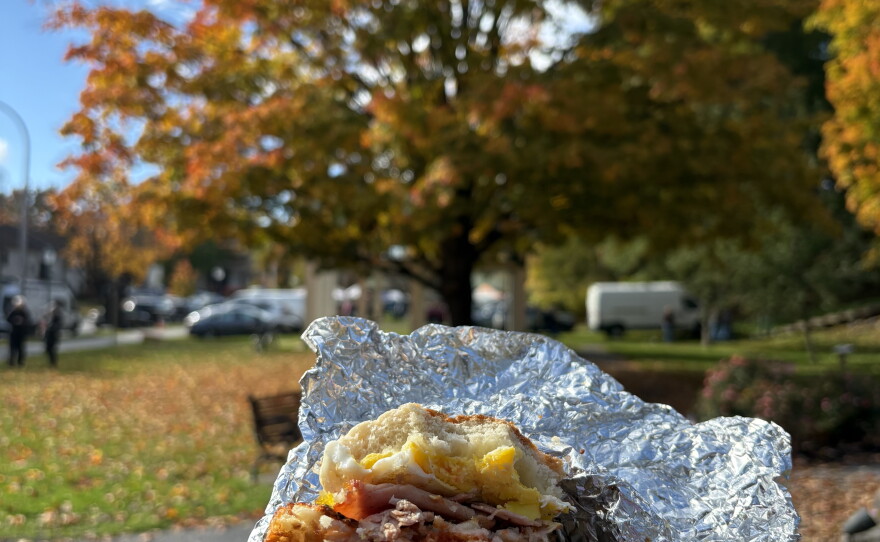
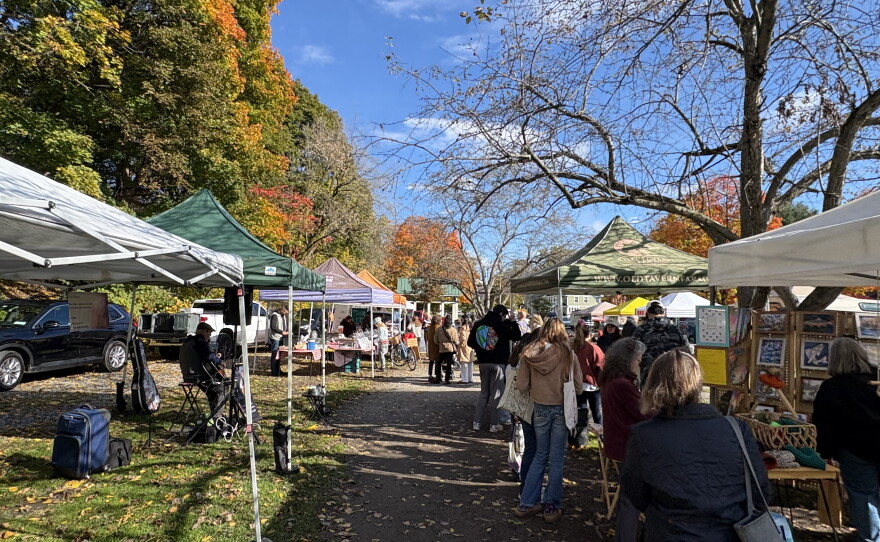
One month ago, WAMC's Southern Adirondack Bureau Chief Aaron Shellow-Lavine took the pulse of local producers at the Saratoga Springs farmers market to try to construct a breakfast sandwich and track the cost of those ingredients. He discussed what he learned with Sam Dingman on Northeast Notebook Live.
INTERVIEW REQUEST
Editor's note: This conversation has been lightly edited for clarity.
Shellow-Lavine: I didn't really find people selling things that would normally go into a breakfast sandwich, let alone somebody selling a sandwich itself. I found beef sellers, vegetable peddlers, maple syrup stands, Coffee trucks - not my intended goal, but we made it work as we always do here. I return triumphant this time around, Mr. Dingman. All right, with plenty of sound of some folks selling breakfast sandwiches.
Dingman: All right, well, let's get into it. What have you got? Who did you talk to?
Shellow-Lavine: Okay, so starting off with Michael Grant, he runs an M and A farm stand, and they sell breakfast sandwiches sourced largely from other folks who are also selling stuff at the farmers market. If not, you know, local producers, you know, within, I would say the Saratoga Southern Adirondacks area, his stand has been providing egg, cheese, protein of your choice sandwiches at the farmers market for years at this point.
Grant: As far as our costs go, we’ve seen not so significant increases as people would be led to believe. I try to keep prices as affordable as possible and the profit margins basically the same. You hear a lot about profit margins going up for people or growing – I’m just content with the way things are.
Shellow-Lavine: So a basic egg and cheese sandwich will run you $6, going all the way up to $8 if you get both of the meat options available. That's sausage and ham on the sandwich; hash browns sold on the side, which you can get incorporated, cost an additional dollar. Grant told me one way they're able to keep their prices so low, and for Saratoga Springs, six to $8 for a breakfast sandwich is more than a bargain. That's by buying locally. It's the same philosophy that I was able to sort of get to the root of the last time I was here talking about costs at this farmers market: when you buy local, you are insulated from a lot of the larger, like we're seeing diesel-driven pressures. That is causing what we're seeing, at least as far as price shock at the grocery store. You don't have to ship things in. You don't have to ship things out if it's local. You avoid a lot of what we are seeing right now as sort of the prime drivers of price rises. So, again, local producers relatively insulated. That doesn't mean Grant hasn't had to raise his prices, though.
Grant: Two years ago I raised the prices $1 across the board. I believe if you’re going to do a price jump, do it significantly so it stands the test of time. And that’s done the trick for us. We have a few people who help us here so we try to take care of them because we come here for the fun of it.
Shellow-Lavine: So that also validates a little bit of the reporting I did last time, where a lot of the people who are, you know, selling locally feel the connection with their customers; you know, they don't want to raise their prices? They will if they have to, and if they have to, they like to do it all at once. Very, very quick side note, if you will allow it, Mr. Dingman.
Dingman: I will.
Shellow-Lavine: Grant's day job is, as we have been talking about already, a trucker. So he had a bit to say about diesel's looming impact. I say looming in particular because I know again the discussion even that we've had right now, what a lot of people are talking about generally is that diesel is already driving prices up. Grant did not have very good things to say about that.
Grant: There’s guys out there that are burning $800, $900, $1,000 worth of diesel fuel a day to make their living. The economy has yet to see an impact of the increase in diesel prices. That usually follows 6 months behind. So, it’s really going to be a problem after the holidays, I think.
Dingman: Well, that's fairly ominous.
Shellow-Lavine: Right? So, I'll have to come back.
Dingman: Yes, but this gentleman was not the only sandwich vendor that you spoke to.
Shellow-Lavine: Exactly. While Grant sources his eggs from local producers, Scott Comeau makes his own eggs. His chickens actually make the eggs. He doesn't, but his breakfast sandwich comes again with locally fresh-sourced English muffins, locally sourced meat from, you know, one or two other stands at the market itself, and one of his own farm's eggs costs $10.
Comeau: Well, I was a chef for 20 years, so I just did the math; it’s an objective price.
Shellow-Lavine: He said that it can be really difficult for local egg producers to keep costs down; while large farms get deals on feed, he’s got to buy it by the 40-pound bag.
Comeau: Everybody’s going about $7, $8 a dozen because of all the input costs and you’ve got to remember the time every day, and in the winter when you’re not making eggs, I still have to take care of those chickens and feed them when they’re not doing it. So, it’s hard to put an actual price on it that makes sense.
Shellow-Lavine: So you know, just a last little note here before we get out of here, at least for this segment. A lot of the eggheads I chatted with noted, at least to me, that egg prices, for the large part, have stabilized. You know, if people remember, at the end of 2024, we saw a pretty severe bird flu outbreak that killed off lots of flocks across the nation, driving prices up. We saw that even locally. Again, just sort of chatting with folks at the market. There was a farm out in Skylerville that did was not impacted very heavily by that bird fly break. That forced them essentially to to raise their prices. You know, sometimes local vendors, their prices go up because they have to just meet market demand. It wouldn't make sense for them to do otherwise. So again, story moral of the story today is is again that that insulation that local vendors get continues. We are seeing to apply for the time being.