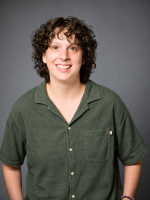
The American Cancer Society says a man's average lifetime risk of getting breast cancer is 1 in 755. Jake Messier is among the fewer than 1% of American men who find themselves as that one. The Pioneer Valley-based social media influencer and advocate has Stage 4 metastatic breast cancer. He was first diagnosed in 2023.
Messier spoke with WAMC's Annie Bennett about the stigma surrounding men getting tested and seeking treatment for breast cancer and his work to end it. Bennett joined Sam Dingman and Maryam Ahmad on Northeast Notebook Live Monday to share a bit of her conversation with Messier.
INTERVIEW TRANSCRIPT
Editor's note: This conversation has been lightly edited for clarity.
Dingman: Alright, Maryam. Well, next up, we're going to dive into some really interesting reporting that our producer Annie Bennett has been doing, and Annie joins us in the studio right now. Hello, Annie.
Bennett: Hello. It's nice to be here on a day other than Fridays.
Dingman: Annie, it is a delight to have you in the studio any day that ends in Y.
Bennett: Thank you very much.
Dingman: Well, and any other day that might later be invented.
Bennett: Just covering all your bases.
Dingman: Yes, exactly.
Dingman: Well, Annie, we invited you in to talk today because you have been following a really interesting and important healthcare story.
Bennett: Yes
Dingman: You spoke with someone last week who has been dealing with metastatic breast cancer. Obviously, that's always very sad to hear about. But this case is a little different than one most listeners might be familiar with.
Bennett: Yes, so Jake Messier is a cisgender man who has Stage 4 breast cancer, and I personally knew that men could get breast cancer, but I didn't really realize that it's not some insanely rare thing, and that there is this epidemic of a fatal lack of awareness about it.
Ahmad: So, how rare is it?
Bennett: Well, OK. So, according to Jake, one in eight women will get breast cancer, which is also way higher than I knew about. One in 38 women will get metastatic breast cancer, and one in 728 men will get breast cancer.
Dingman: Here's a little bit from Jake on that.
Messier: People are like, "Oh my gosh, that's so rare!" No, hitting Powerball is rare, right? That's like one in 18 million, right?
Dingman: So earlier, Annie, you said there's a "fatal lack of awareness." That's not just hyperbole.
Bennett: No, Jake told me that the lack of education for men about breast cancer can often postpone diagnoses, and Massachusetts, where Jake lives, is home to the only male breast cancer clinic in the entire world.
Messier: So I first found a lump in my armpit in March of 2023, and I basically said, "Well, that's weird," and I went on with my day, right? And I think that goes to the point that young women, girls, are taught in sixth grade health class, right? You find a lump, you tell somebody, right? And boys are never taught this.
Bennett: And Jake says he didn't actually say anything about the lump until his primary care visit six months later. [He] said he wasn't even really going to bring it up, but he had an appointment, might as well. And the gendered approach to breast cancer, even once people are diagnosed, often discourages men from seeking treatment. I mean, he told me that even he would admit he felt pretty emasculated at first.
Messier: The reason why male breast cancer is 30% more fatal — it's not because the disease is more aggressive — is because of the psychosocial issues that go along with having a woman's disease.
Ahmad: That's interesting because oftentimes breast cancer is portrayed as a feminist issue.
Bennett: Yeah, and it is, and Jake even agrees with that.
Messier: I went to Senator Markey's and Senator Warren's offices and talked to them about what we would like to see in terms of metastatic breast cancer funding. But yeah, at the end of the day, I think the more older white men that know that breast cancer could affect them, there would probably be less questions on breast cancer funding overall.
Bennett: Jake told me that he is very passionate about gender equality, and one of the concerns is that he doesn't want to take up space inappropriately. So he says that he has a hard time finding a balance that makes sense to him because he wants to make sure that women are uplifted, but also that his story is heard because lives are literally at stake.
Messier: The guys that have been beaten down for a long time by just trying to say, "Hey, I've got breast cancer too," and, you know, I've been told straight to my face that a man's voice doesn't belong in breast cancer ... I've been told by a woman that I'm taking away her voice, and I'm like, I'm not trying to take away your voice. I'm just trying to make mine heard, right? I'm just trying to make the male voice that, if you are a human being, you can get breast cancer. That's at the end of the day, you know, that's the story. It doesn't matter about gender, any gender. You could take gender completely out of the conversation.
Dingman: I have to say, Annie, this sounds like a conversation that was pretty delicate at certain points and tough to navigate. I would imagine for Jake from a lot of different angles.
Bennett: Yeah, and you know, he talked about how even though it can seem like a non-issue, when you gender something like a cancer, you're also sometimes alienating trans people or non-binary people that are being affected by this. And I don't know, it just really got me thinking about the nuance that goes into representation, and I found it very, very enlightening.