

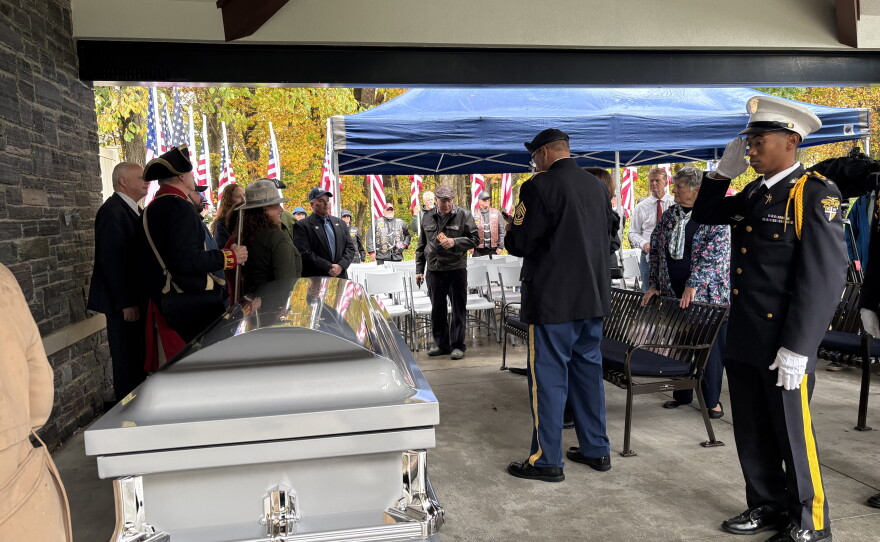
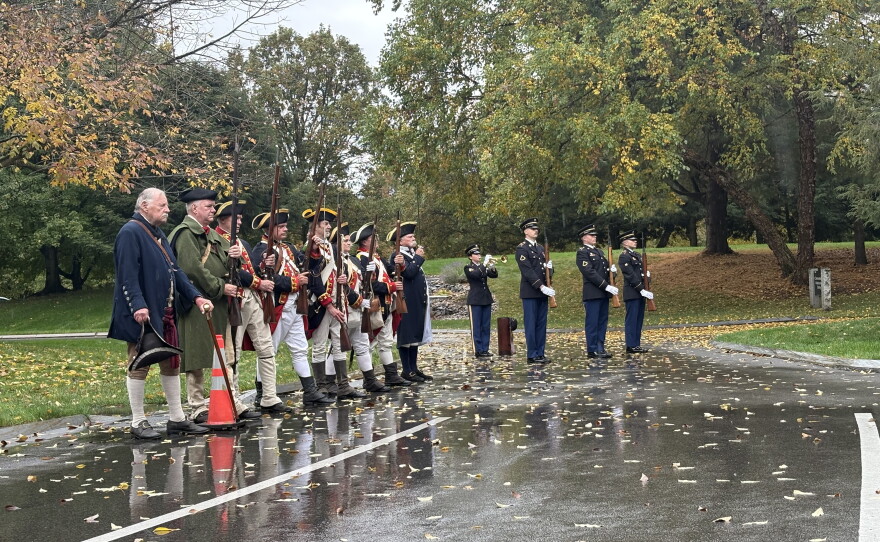
250 years after the Battle of Valcour Island, the remains of Continental Army soldiers who died in the conflict have been laid to rest in Saratoga County.
It was a fitting day for a funeral – gray skies and rain clouds saturated Gerald B.H. Solomon Saratoga National Cemetery’s grounds Tuesday.
Dozens gathered in the dampness to hold a military funeral 250 years after the fact for soldiers who died as the gun boat Philadelphia sunk to bottom of Lake Champlain.
“Led by Brigadier General Benedict Arnold, the hundreds of officers and soldiers under his command crewed 15 vessels for the purpose of defending Lake Champlain as best they could against inevitable British attack from Canada,” said Eric Schitzer.
That attack would come in October 1776, as Saratoga Battlefield Historian Eric Schnitzer noted at the opening of this week's ceremony.
“The resultant Battle of Valcour Island was a long, hard-fought attempt by our forces to defend the northern region of our new sovereign country, despite the bravery, heroism, and sacrifice, we were outmatched, and the battle was a loss for the American cause,” said Schnitzer.
Jennifer Jones is one of the minds behind the Gunboat Philadelphia Preservation Project at the Smithsonian National Museum of American History.
“This boat was built in 1776. In about three weeks time in July of 1776, weeks after the ink on the Declaration of Independence was drying, really very early in our independence declaration, and it was on the lake by 18th of August of 1776,” said Jones.
The boat sank on the Battle of Valcour Island’s first day — Oct. 11.
The remains would stay at the bottom of Lake Champlain for nearly 200 years – civil engineer Lorenzo Haglund recovered the ship in 1935 and the Smithsonian then acquired it in 1961.
“This has been something a long time in the making. We had an idea that because we had these human remains, we wanted to do something, and because it's the 250th of the founding of our country. This would be an appropriate time to do that,” said Haglund.
While the three-day Battle of Valcour Island was ultimately a loss for the American forces, their efforts were not in vain: the British military was delayed enough to allow the Americans to prepare better for the eventual Battle of Saratoga one year later.
That battle delivered a crucial win the Americans who were then able to secure the support of the French — historians call the Battle of Saratoga the turning point of the American Revolution.
Saratoga County Historian Lauren Roberts said the national cemetery was a fitting place of rest for the Continental Army soldiers.
“You can't walk in Saratoga County, I think, without realizing our connections to the revolution. And now is the time to get out and understand and appreciate all of that history. You don't have to travel to learn about the people, both in the military and the citizens that were affected by it, and also those that came after them and preserved the history,” said Roberts.
Major General Ray Shields, commander of the New York National Guard, got emotional during the funeral.
“The military is all by human beings, and so really, you think the major thing that has changed is the equipment that's used, but the same hardships that they went through in in October in the winter on a lake are the same things that U.S. Army soldiers experience today,” said Shields.
